Our Pro Tools course provides in-depth training for recording and producing music in the engineers choice, and recording & mixing studio standard DAW. It doesn’t matter what genre the music you work with is, if you want to use Pro Tools to create your tracks, this course will cover the music production and engineering skills you need. Even if you are a more experienced Pro Tools user you will benefit from this course, as all of the elements will be covered in detail, peppered with loads of practical real-world tips – giving you the edge over anyone learning any other way. Total class time is 36 hours where you can ask a question and bounce off of your instructor and fellow learners exactly when you're feeling inspired, or …confused! This is why some say that there is no substitute for music production courses in person. On successful completion of the course, you will receive an industry-recognized certificate.
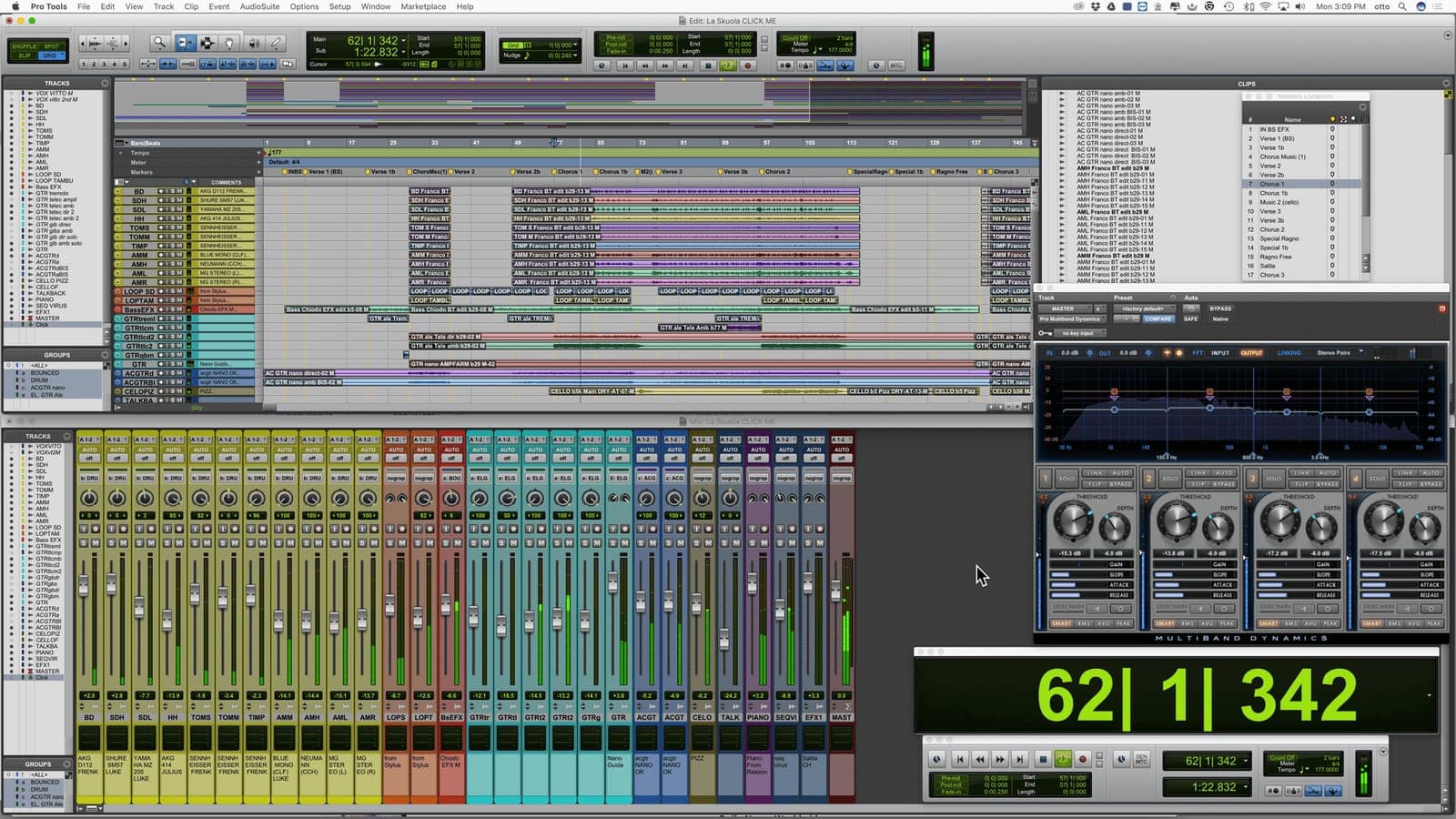
Pro Tools Class | Nashville
Pro Tools Course
Getting Started
- →Software installation, toolkits, iLoks & licenses
- →Avid hardware and other compatible interfaces
- →Launching Pro Tools & session start up
- →File format, bit depth & sampling rate tips
- →Pro Tools file structure and file management
- →Edit & mix window introductions
Advanced Editing Techniques
- →Clip based gain and automation
- →Pencil tool, TCE (Time Compression Expansion Tool)
- →Strip silence and tab to transient and consolidating clips
- →Repeating and duplicating clips
- →MONO, stereo and panning
- →Overview and automation for plugins and effects
Workflow
- →Edit window orientation
- →Importing audio, creating and track arranging tips
- →Edit modes - all about Slip, Spot, Shuffle & Grid
- →Multi-tool (Trimmer, Grabber, Selector)
- →Transport window - tempo, pre & post roll count off
- →Grid and nudge values
Recording Techniques and Introduction to Sound Design
- →Balancing, introduction to the art of mixing. Group tracks and advanced uses of routing
- →Introduction to sound waves, frequency, and amplitude
- →The recording patch in detail, introduction to gain structure
- →EQ and compression for recording
- →Foldback, headphone mixes, and latency
- →Digital, analog, sampling rate and bit-rate explained
- →Microphones overview and stereo miking techniques
- →Recording specific aspects of Ableton
- →Compiling audio takes
Samples & Loops
- →Creating drum loops in Pro Tools
- →MIDI controllers and editing MIDI
- →Printing software Instruments
- →Master Fader, VU and peak meters
- →Beat Detective - time correct live drums
- →Exporting audio, bouncing mixes and dithering
The Final Product
- →Preparing your session for mix-down
- →Consolidating audio and cleaning up your session
- →Exporting MP3s and Editing METADATA
- →Mixing techniques for post production, including film & TV
- →Key command shortcuts’ review
- →0dbfs and digital clipping
In Nashville, a city built on songwriting and recording, this course is taught by producers who work in its studios. Classes are small and hands-on, and the same sessions are available live online, using our specialist music collaboration software, Muse.
Student reviews.
“The course is very friendly and engaging. Any and all questions will be asked with no hesitation or frustration, and it helps everyone else in the class that might have the same question in mind.”
Ryan Conway
Instructors

Common questions, answered.
An industry-recognized certificate on successful completion.
Controller keyboards and headphones are provided to every student regardless of whether you bring your own laptop.
None required - even experienced users benefit, since every topic is covered in detail with practical tips you won't pick up on your own.
Yes - a shorter 1:1 option is available alongside the 36-hour group course; see Pro Tools Private Instruction to connect with a specialist.
Everything from installing the software and setting up your first session to advanced editing, recording technique, EQ and compression, sound design basics, and finishing a session ready for release.
Bring your own if you can - it's more affordable and you keep your project exactly as you left it. No laptop is fine too; hiring an iMac with the software loaded adds a $75 supplement.
$1499 + $100 Registration if booked 14 days before start or $1799 + $200 Registration
Let's get you started.
InquireCamel Audio’s Alchemy, NI’s Absynth and Propellerhead’s Malstrom
Additive Synthesis: breaks sound down into its harmonics, creating timbre by adding sine waves together Granular Synthesis: creating sounds by playing waveforms and/or samples through a synthesis engine that operates like a sampler on the microsound time scale So, what can you achieve by running som
Read →Antares Autotune pitch correction software on Xfactor shows
Antares Autotune pitch correction software on Xfactor shows: I had a chap called Will Payne from the Sunday Mirror contact me and ask if I could spot any Antares Auto-tune pitch correction software on Susan Boyle's pre-recorded audition performance of 'I Dreamed a Dream' on Britain's Got Talent, whi
Read →Which DAW is best? – Logic, Pro Tools, Ableton or Cubase?
- Al Riley My first multitrack workstation was my 4-track Portastudio (not a DAW, an AAW I suppose?), which gave me the novel luxury of changing the volume and panning different instruments after recording them! I could even use insert effects (a guitar pedal) and punch-in recording to fix questiona
Read →Which DAW is better – Logic, Pro Tools, FL, Ableton or Cubase?
When I very first started in the early-nineties, we all used Atari STs with a whole 512k of Ram for sequencing MIDI and not much else. All the audio was dealt with using 24 track 2" tape, with up to 3 slaved together synchronised using lynx synchronisers. Back then for sampling, we had the classic A
Read →Logic Pro training: Zoom tool and using loops with regions
Logic Pro training: Zoom tool and using loops with regions: I made a video at my studio about zooming for Logic Pro Training. I don't know how I managed to talk about zooming for over 6 1/2 minutes but I love it. The first 4 minutes can get a bit tedious if you're familiar with all the weird and won
Read →Apple Logic Pro with Avid Pro Tools HD DAW Systems
Apple Logic Pro with Avid Pro Tools HD DAW Systems: I heard here that Apple (Logic) are to stop support for Avid's Digidesign products (Pro Tools). This is a massive kick in the teeth for Avid who I here are struggling a bit at the moment. Neither rumor surprises me; I cashed in my (digital signal p
Read →